
Our Location
304 North Cardinal St.
Dorchester Center, MA 02124

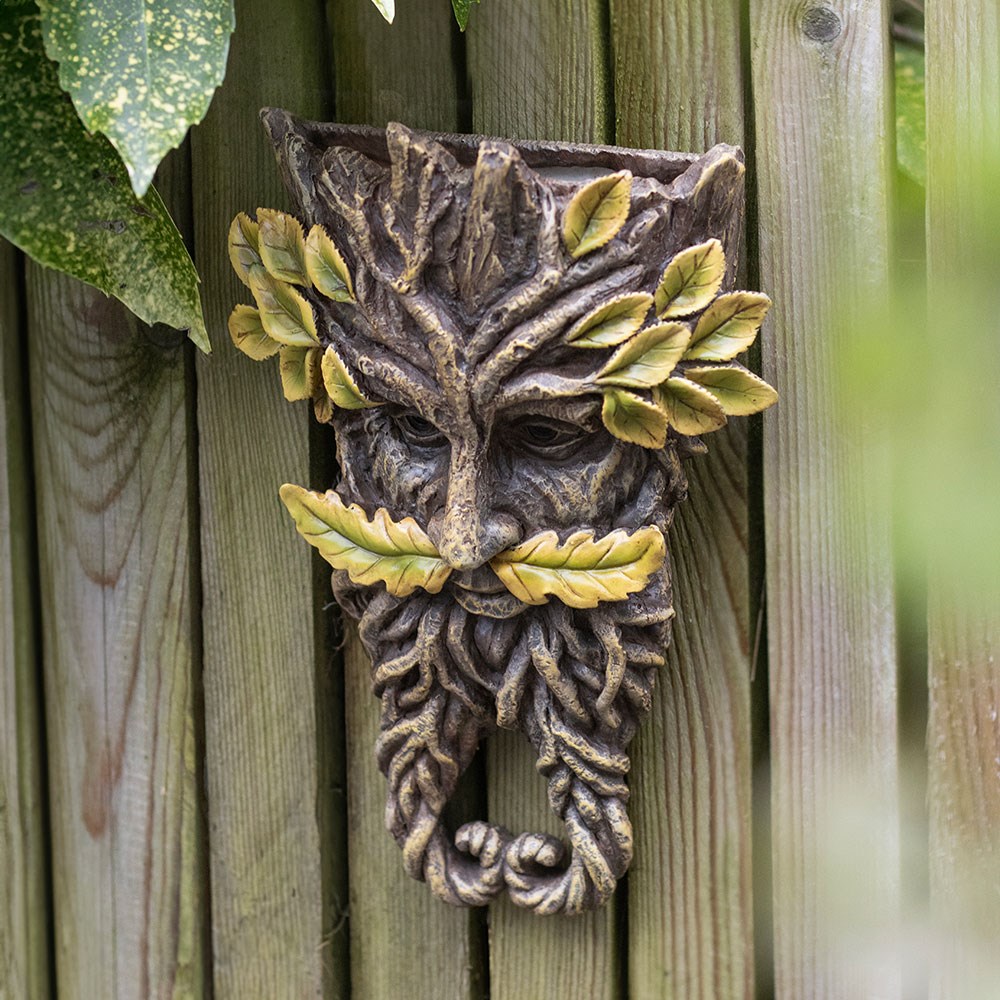
If you’ve ever walked through an old European church and spotted a face peering out from a tangle of leaves, you’ve met the Green Man. This ancient, mysterious figure has watched over humanity for thousands of years — and he’s more popular today than at any time in recent history.
The Green Man is a symbolic figure: a face (usually male) formed entirely from leaves, vines, and foliage. He appears in carvings, paintings, stained glass, and architecture across the world. Unlike a specific god with a single mythology, the Green Man is an archetype — the spirit of nature itself, the cycle of growth and decay, the untamed wild that can’t be controlled.
Scholars typically identify three main forms of the Green Man, each with its own meaning:
The most common form: a face surrounded by or made entirely of leaves. Sometimes leaves grow from his mouth, eyes, and nostrils. This is the classic Green Man you see on pub signs, garden walls, and pagan altars.
Leaves or vines pour from the mouth — symbolizing abundance, fertility, and the earth’s endless creative power. This form appears on Roman mosaics and medieval church carvings alike.
The figure looks out from a frame of leaves with a solemn, meditative expression. This is the Green Man as wise observer — watching over the forest and all its creatures.
Green-faced figures date back over 2,000 years in ancient Middle Eastern art. The “Green Man” motif appeared in Assyrian and Babylonian reliefs as a symbol of vegetation and fertility. Some scholars trace his roots even further back to Indus Valley civilisation.
In Celtic mythology, the Green Man is closely linked to Cernunnos — the antlered god of the forest, animals, and the underworld. Cernunnos appears on the famous Gundestrup Cauldron (1st century BCE) and was worshipped across Celtic Europe.
The Green Man also connects to Jack in the Green — a folk figure who appears in May Day celebrations across England, covered entirely in green foliage and leaves. This tradition dates back to at least the 16th century and may have much older pagan roots.
Roman art featured “heads of vegetation” — faces emerging from acanthus leaves — on sarcophagi, temples, and villas. When the Roman Empire spread across Europe, these decorative motifs travelled with them and merged with local Celtic and Germanic nature traditions.
One of the most surprising places to find the Green Man is in Christian churches. During the Middle Ages, he appeared as a architectural carving on cathedrals, parish churches, and manor houses across England, France, Germany, and beyond.
Why would a pagan nature spirit appear in a Christian building? Scholars debate this. Some say the Church tolerated him as a symbol of spring and rebirth — easily reinterpreted as resurrection. Others argue the stonemasons, many of whom held old folk beliefs, quietly slipped the Green Man into the buildings they built — a secret tribute to the old ways.
Whatever the reason, the Green Man thrived in medieval Europe. He appears on corbels, misericords, roof bosses, and doorways — often looking down from above, as if watching over the congregation below.
The leaves die in autumn and return in spring. The Green Man embodies this eternal cycle — death is not an end, but a necessary part of rebirth. He reminds us that every ending is followed by new growth.
In Wicca and modern paganism, the Green Man is the Horned God — the masculine energy that balances the Goddess. He’s the forest, the hunt, the sun on your face, the soil beneath your feet. In a time when healthy male spiritual role models are scarce, the Green Man offers a vision of masculinity that is connected to nature, not domination.
We modern humans have built a world of concrete and screens. The Green Man reminds us that we are part of nature, not separate from it. When you look into his leaf-covered face, you’re looking at your own wild, untamed roots.
The leaf face pouring forth foliage is a celebration of the earth’s bounty. He represents the fertile soil, the growing season, and the harvest that sustains us.
For modern Wiccans, Druids, and pagans, the Green Man is a beloved figure:
Place a Green Man statue or wall plaque on your altar as a representation of God energy. Light a green or gold candle and invite his presence.
Go into a forest or park. Sit with your back against a tree. Meditate on the Green Man energy. Feel the tree’s slow breathing. Listen to the wind in the leaves. You may sense his presence watching over you.
Call upon the Green Man in rituals for:
A Green Man plaque by your front door or in your garden invites nature energy into your space. It’s also a beautiful conversation piece — everyone who sees it asks, “What does it mean?”

“I’ve loved the Green Man since I first saw him carved on a church roof in Yorkshire. I bought this twisted beard plaque for my garden and it’s even more beautiful in person. The detail is incredible and it feels like the forest itself is watching over my home. I’ve already ordered a smaller one for my indoor altar.” — Angela W., Leeds
“As a Druid, the Green Man is central to my spiritual practice. This wall plaque is beautifully made — the leaves and beard are intricately detailed. It hangs above my altar and I light a green candle before rituals. It feels like connecting to something ancient and real.” — David H., Edinburgh
“I bought this as a gift for my partner, who’s really into pagan spirituality. He was blown away by the quality. The Green Man design is so detailed and it looks great on our living room wall. Shipping was fast and it arrived well packaged.” — Sarah B., London
In our digital, disconnected age, the Green Man offers something we desperately need: a reminder that we are part of the natural world. He doesn’t care about your social media following, your job title, or your bank balance. He just is — wild, green, and eternal.
He also offers a vision of masculinity that the modern world has forgotten: not dominance over nature, but partnership with it. Not control, but relationship. This is a vision we desperately need as we face climate crisis and ecological collapse.
Browse our Green Man collection and bring the spirit of the forest into your home and spiritual practice.
