
Our Location
304 North Cardinal St.
Dorchester Center, MA 02124

Which crystals do people use for anxiety? A practical guide to 9 calming stones, how to choose one, and how to use them without overpromising.
Read more: beginner’s guide to crystal healing.
If you came here hoping a stone would switch off your anxiety, it won’t — and any shop that tells you otherwise is selling you something worse than a crystal.
What stones can do is give you a physical anchor. Anxiety is a loop: your body tenses, your mind reads the tension as danger, the tension increases. A small, smooth object in your pocket interrupts that loop because it gives your hands and your attention somewhere to go. That’s the same principle behind worry stones, prayer beads and fidget rings — and it’s why so many people who use crystals seriously still describe them as a practice rather than a cure.
The stones below are the ones most often reached for in that spirit: not because they’re magic, but because they’re easy to hold, easy to carry, and tied to a tradition that tells you what to do with them.
Browse our chakra stones.
You don’t need nine stones. You need one that you’ll actually carry.
The most common “calm” stone in the UK, and the easiest to find in any form — tumbled, tower, cluster or a small carved point. Traditionally associated with quieting an overactive mind, which is why it’s the stone most often kept on a bedside table.
Best for: racing thoughts at night. Skip if: you want something to hold during the day — amethyst clusters are too fragile for a pocket.
Soft pink, widely available, and traditionally linked with self-compassion. Anxiety often comes with a harsh inner voice; rose quartz is the stone people reach for when the problem is how they’re speaking to themselves.
Best for: a desk or handbag stone. Note: it scratches easily, so keep it in a pouch.
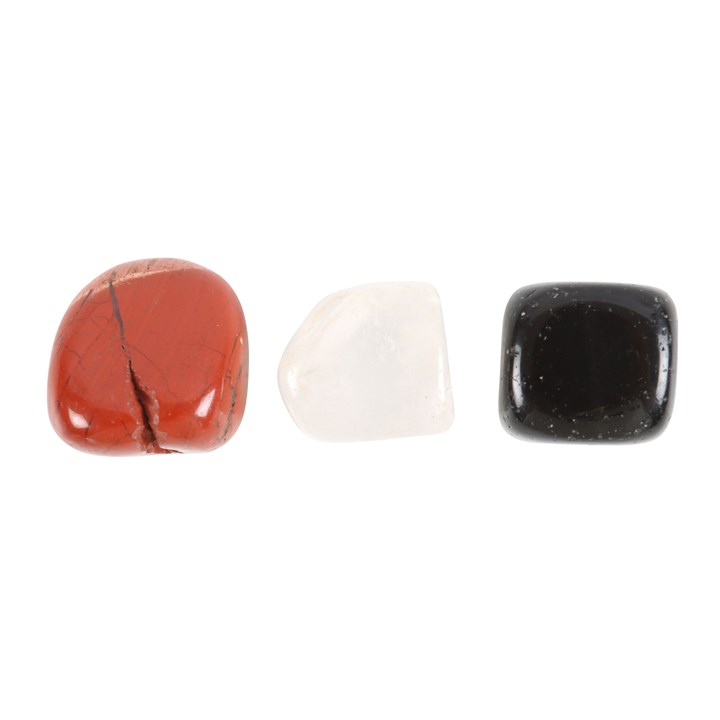
The classic protection stone, and the most requested in our shop after amethyst. It’s dense and dark, which makes it feel grounding in the hand — that’s the practical reason people like it, whatever you believe about its energy.
Best for: people who feel anxious in crowded places or unfamiliar rooms.
Often described as the “quiet” version of black tourmaline: same grounding quality, lighter to carry, and it doesn’t look like a rock you picked up in a car park. Good for a first “serious” stone.
Best for: a work desk or a bag pocket.
A soft, translucent white stone that’s usually sold as a wand or a charging plate rather than a pocket piece. It’s traditionally used to clear other stones, which makes it a practical first purchase if you’re building a small collection.
Best for: a bedside piece, or a plate to rest your other stones on. Important: selenite dissolves in water — never wash it.
The one people don’t expect. It’s a lilac mica, often sold as a small tumbled stone, and it’s traditionally associated with easing worry and sleep. It’s also one of the few stones with a genuinely soft, matte texture, which makes it pleasant to hold.
Best for: night-time worry. Note: it’s layered and can flake at the edges — handle gently.
White with grey veining, cheap, and traditionally used as a “calm down” stone. It’s often dyed blue and sold as “blue howlite” — genuine turquoise it is not, so check before you pay turquoise prices.
Best for: a first stone if you’re not sure you’ll stick with the practice.
A pale blue banded stone associated with calm communication — useful if your anxiety shows up as not being able to say what you need. Smaller pieces are common and inexpensive.
Best for: a pocket stone you can hold during a difficult conversation.
The blank canvas. It has no single fixed association, which makes it the stone people use to “set” an intention — you decide what it’s for. For anxiety, that usually means holding it while you breathe slowly and telling yourself what you’re working on.
Best for: anyone who wants to build their own meaning rather than inherit one.
Every crystal guide tells you to cleanse your stones. The honest version: there’s no evidence that a stone accumulates anything, but the practice is a useful ritual and it keeps the stone clean. Running water, dry salt, moonlight or a selenite plate all work; our guide to clearing and charging crystals covers which stones can and can’t get wet.
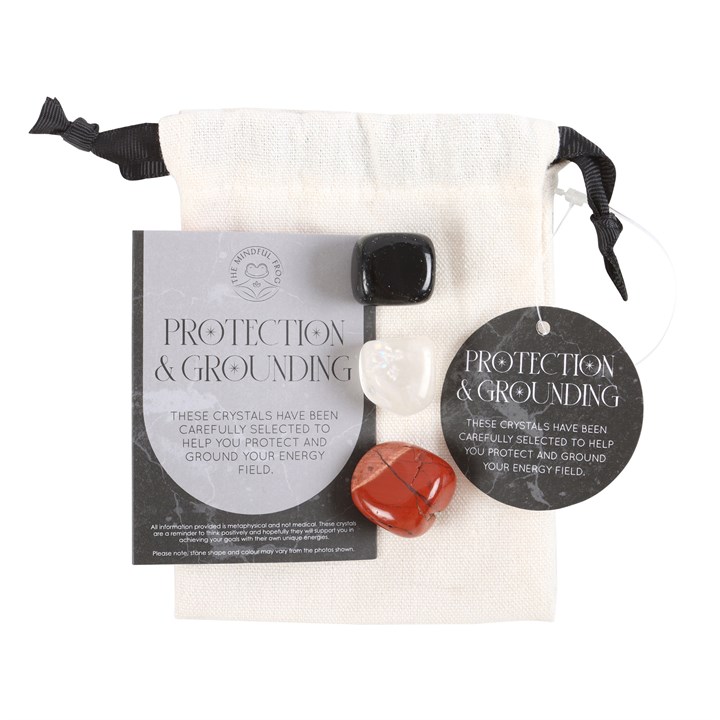
Shop the Protection & Grounding Crystal Set.
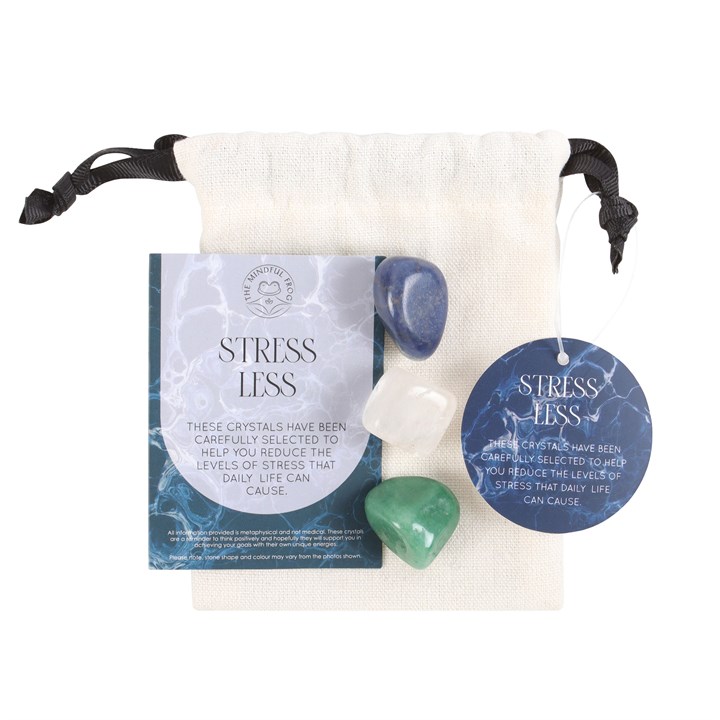
Shop the Stress Less Healing Crystal Set.
Start under £15. A tumbled stone or a small palm stone is enough, and you’ll learn more from carrying one cheap stone for a month than from buying a £60 set you never touch. If you want to try several, the pre-made sets in our crystal collection group them by purpose — the protection and the calm and sleep sets are the two that make sense for anxiety-adjacent use.
If anxiety is affecting your sleep, your work or your relationships, a crystal is not the tool you need. Talk to your GP. In the UK, you can also self-refer for NHS talking therapies without seeing a doctor first, and Mind’s website has a plain-English guide to what’s available.
Crystals can sit alongside that support. They can’t replace it.
This article is for general information and isn’t medical advice. Crystals are not a treatment for anxiety or any other condition.
Ready to dive in? Start with crystal collection, then browse the full shop. Free UK delivery on orders over £30. New here? Join our newsletter for a first-order code.
Amethyst is the most commonly chosen, mainly because it’s easy to find in a size you can hold. Lepidolite is the one people reach for specifically at night, and black tourmaline is the usual pick for anxiety in crowded or unfamiliar places. If you only buy one, choose whichever you’ll actually carry.
No. There is no evidence that crystals treat anxiety or any other condition, and this article doesn’t claim otherwise. What they can do is give your hands and attention somewhere to go, which is the same principle behind worry beads and fidget tools. If anxiety is affecting your sleep, work or relationships, speak to your GP — in the UK you can self-refer to NHS talking therapies without a referral.
Running water, dry salt or moonlight are the three simplest methods. Check first that your stone can take water: selenite dissolves, and lepidolite, howlite and dyed stones shouldn’t be soaked. A selenite plate is the low-effort option — you rest the stone on it and do nothing.
One. A single palm stone or tumbled stone you actually carry will do more than a set of nine sitting in a drawer. The sets are useful if you want to try several before committing, but start with one and use it for a month.
Wherever you’ll touch it without thinking — a pocket, a desk, or the bedside table. Bedside placement works well for night-time anxiety because seeing the stone is itself the reminder to slow down. A crystal kept somewhere you never go is decoration.
Join our list for a first-order discount and early access to new pieces.
